The Heritage of Innovation: Working with Constraints as Medicine's Founding Tradition
Confronted with the modern mandate to "do more with less," this article argues that working within constraints is not a compromise on care, but medicine’s founding tradition. By examining how severe resource shortages historically drove breakthrough innovations—such as Florence Nightingale’s process improvements at Scutari (1854) and Dr. Bjørn Ibsen’s invention of the Intensive Care Unit (1952)—the author reframes LEAN methodology as an inherent clinical instinct. In the Malaysian public healthcare sector, these ad-hoc, constraint-driven efficiency gains are now being systematically institutionalized as official national policy under a new directive from the Director-General of Health.
Dr. Saiful Safuan Md Sani
National Head of Internal Medicine Specialty, MOH Malaysia
June 25, 2026
8 minutes
V1.0
There is a phrase that circulates with striking regularity across healthcare systems, particularly in times of resource strain. It is offered, sometimes apologetically and sometimes as instruction, as a kind of policy shorthand for an irreducible reality: do more with less.
For physicians working in Malaysia's public health system, this phrase can feel less like an invitation and more like a verdict. They manage ward capacities beyond design limits, carry specialist rosters with unfilled positions, and run departments where the gap between clinical need and available resource is a daily negotiation. It implies that the problem is operational, that the solution is attitudinal, and that the medicine of scarcity is fundamentally different from the medicine we might otherwise aspire to practise.
This article argues the contrary. Working within constraints is not a regrettable departure from the tradition of modern medicine. It is, in the fullest historical sense, that tradition's very foundation. The most consequential innovations in our profession's history, including the standardisation of clinical environments, the measurement of process-related mortality, and the invention of intensive care, were born not in conditions of abundance, but in conditions of acute shortage. LEAN methodology, properly understood, is not a corporate framework imposed on clinical work. It is a formal articulation of what great clinicians have always done when the system breaks around them.
This piece was written as a companion to the welcoming address delivered at the Bengkel Pengukuhan dan Perluasan LEAN-Based Healthcare, attended by Heads of Department of Internal Medicine from across Malaysia. The argument is historical. The evidence is clinical. And the implication, I hope, is motivating.
I · Scutari, 1854
Florence Nightingale and Process Improvement
On the Asian shore of what is now Istanbul, in a district called Scutari, stands a vast Ottoman barracks building that, between 1854 and 1856, served as the primary hospital for British soldiers wounded in the Crimean War. Its clinical record remains, by any measure, extraordinary. Not for the care it delivered, but for the deaths it caused.
The Scutari Barracks Hospital, c. 1856. Built as an Ottoman military barracks, it became the principal British military hospital during the Crimean War, and the site of Florence Nightingale's most consequential work.Source: National Army Museum, London · collection.nam.ac.uk/detail.php?acc=1979-11-26-1
Of the 17,580 British soldiers who died during the Crimean campaign, only 4,602 died from battle wounds, fewer than one in four. The majority died from typhus, cholera, and dysentery. There were, at certain periods, barely bandages. On the twelfth of October 1854, a correspondent for The London Times sent back a dispatch that crystallised the public's growing alarm:
The London Times · 12 October 1854
"Not only are there no wound dressers and nurses... but what will be said when it is known that there is not even linen to make bandages for the wounded?"
The political pressure that followed led Sidney Herbert, then Secretary at War, to enlist and dispatch Florence Nightingale to Scutari with a contingent of thirty-eight nurses. What followed has been largely mythologised as the Lady with the Lamp walking the wards by night, but this obscures the more significant and more instructive truth about what Nightingale actually did.
Florence Nightingale in the Military Hospital at Scutari. A contemporary lithograph depicting Nightingale tending to wounded soldiers, the image that defined her public reputation, though it tells only part of the story. Source: National Army Museum, London · collection.nam.ac.uk/detail.php?acc=1978-10-57-1
She did not request more staff. She did not wait for a larger budget allocation. She observed the system. She walked the wards and traced the origins of the mortality data she was compiling with meticulous care. What she found was a catastrophic failure of process. The processes of patient care were themselves killing soldiers.
And she did something that, in retrospect, represents one of the earliest examples of data-driven quality improvement in clinical medicine: she developed a visual representation of the mortality data that could not be ignored.
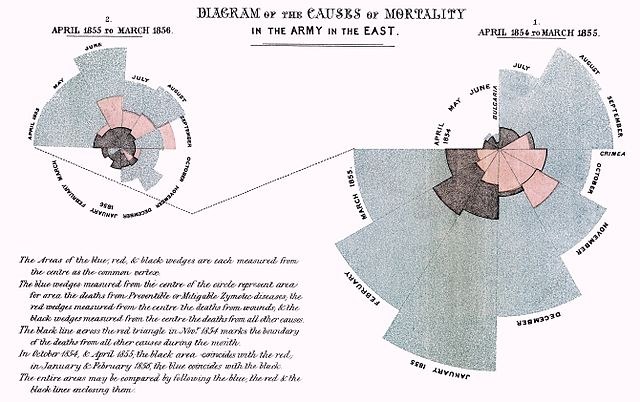
Working with William Farr, a statistician, Nightingale developed what became known as the polar area diagram, or coxcomb chart. The diagram mapped the causes of soldier deaths month by month over the course of the war. Its argument was undeniable at a glance: the hospital, not the battlefield, was the primary source of mortality.
Nightingale's polar area diagram ("coxcomb chart"), 1858. Each wedge represents a month; the area shows deaths from preventable disease (blue), wounds (red), and other causes (black), making the argument visible at a glance.
"To affect through the Eyes what we fail to convey to the public through their word-proof ears."
Florence Nightingale, on the purpose of the polar area diagram, 1858. Decades ahead of its time as an instrument of data visualisation for policy change.
The outcomes were documented:
Not a single new resource was introduced. No additional nurses arrived from London. No new wards were constructed. The outcome was the product of a systematic analysis of process failures, followed by targeted intervention against each one.
When Nightingale presented her findings to Queen Victoria at Balmoral Castle in September 1856, she told the monarch directly: the British military's own hospitals had killed more soldiers than the enemy. The Queen's response, "Such a clear head. I wish we had her at the War Office," was not merely personal admiration. It was a recognition that what Nightingale had practised was a form of institutional intelligence that the military bureaucracy conspicuously lacked.
What Nightingale had practised, in the language of a later century, was in essence LEAN methodology. She had identified waste in the system: wasted motion, wasted clinical time, wasted lives attributable to avoidable process variance, and eliminated it through observation, standardisation, and the rigorous use of data. She had done this not because resources were plentiful, but precisely because they were not.
II · Copenhagen, 1952
Dr. Bjørn Ibsen and the Accidental Invention of Intensive Care
A century later, and in a context apparently unrelated to process improvement, the same dynamic, constraint as the engine of clinical innovation, produced what remains one of the most consequential structural advances in the history of hospital medicine.
In August 1952, Copenhagen was in the grip of one of the most severe poliomyelitis epidemics in European history. Blegdams Hospital, the city's principal communicable disease centre, was admitting up to fifty patients daily. A significant proportion presented with bulbar and respiratory forms of the disease, leaving them unable to sustain independent ventilation. The standard of care for respiratory failure at that time was the iron lung, a negative-pressure ventilator that enclosed the patient's body and created the mechanical conditions for passive respiration.
An iron lung in use, early 1950s. The negative-pressure ventilator was the standard of care for respiratory failure. Blegdams Hospital, however, had only one, against a census of hundreds of critically ill patients.Source: BBC Future · bbc.com/future/article/20240315-iron-lung-led-to-creation-of-modern-day-intensive-care-unit
Blegdams Hospital possessed one iron lung and six cuirass ventilators. Against a census of critically ill patients numbering in the hundreds, this represented a resource deficit that was not merely serious but, in terms of conventional treatment pathways, insurmountable. The mortality rate for bulbar poliomyelitis at the time of the epidemic's peak was 87%.
The chief physician, Dr. Henry Lassen, consulted Dr. Bjørn Ibsen, an anaesthesiologist then working at Copenhagen Municipal Hospital. Ibsen's response was not to enumerate the limitations of the available equipment. It was to ask a question that, in retrospect, was both simple and radical:
"What does the iron lung actually do? And can we do it another way?"
Dr. Bjørn Ibsen, Blegdams Hospital, August 1952. The question from which modern intensive care was born.
The iron lung, stripped to its essential clinical function, moved air in and out of lungs. Ibsen proposed that this function could be replicated manually: by performing tracheostomies on patients in respiratory failure and ventilating them with positive pressure through a simple rubber bag, compressed by hand. The technique was inexpensive, immediately replicable, and, critically, not dependent on equipment that did not exist in sufficient quantity.
The logistical challenge this created was considerable. Manual ventilation twenty-four hours a day, seven days a week, across a ward of critically ill patients, required a volume of continuous human presence that the hospital's medical and nursing staff could not provide alone. Ibsen and the hospital administration responded by mobilising 1,500 medical and dental students from the University of Copenhagen, organised into shifts to sit at bedsides and sustain manual ventilation through the days and nights of the epidemic.
The epidemiological outcome was transformative. But perhaps the more lasting consequence of Ibsen's intervention was structural rather than statistical. The concentration of the most critically ill patients in a single designated area, monitored continuously by a dedicated and organised clinical workforce operating in structured shifts, was a configuration that had never previously existed in hospital medicine. It did not yet have a name.
It would later be named the Intensive Care Unit.
The ICU, now a standard feature of every acute hospital in the world and the environment in which modern resuscitation, post-operative care, and critical illness management are delivered, was not the product of a research programme, a capital investment initiative, or a technology transfer. It was the accidental consequence of a clinician who, confronted with an equipment shortage of catastrophic proportions, declined to accept the problem as stated and instead asked a different question.
III · The Argument
LEAN as Clinical Heritage, Not Corporate Import
The significance of these two cases for contemporary clinical leadership is not merely inspirational. It is structural. Both Nightingale at Scutari and Ibsen at Blegdams were, in formal LEAN terms, practitioners of value stream analysis. They identified the steps in a clinical process, distinguished those that produced value from those that consumed resource without producing care, and redesigned the system accordingly. Neither used the vocabulary of LEAN. Neither had been introduced to the Toyota Production System. What they had, instead, was the diagnostic instinct of excellent clinicians applied to a system rather than a patient.
This reframing matters. There is a legitimate professional scepticism among clinicians about management methodologies that arrive from outside medicine, from manufacturing, from aviation, from service industries, carrying claims of universal applicability. That scepticism is not unreasonable. But it misapprehends the origins of LEAN as it has been applied in healthcare.
The core of LEAN methodology, namely the identification and elimination of waste, the standardisation of reliable processes, and the use of data to make variation visible, is not foreign to clinical thinking. It is the formalisation of an instinct that clinicians have exercised throughout the history of the profession, most powerfully in precisely the conditions that characterise contemporary Malaysian public healthcare: high volume, constrained resource, and the permanent pressure of unmet demand.
Central Argument
Nightingale did not need more beds. Ibsen did not need more machines. They needed to see what they already had, differently. The medicine of constraint is not an inferior version of the medicine of abundance. Historically, it has been the more generative of the two.
IV · The Malaysian Context
From an Innovation Workshop to National Mandate
The Bengkel Pengukuhan dan Perluasan LEAN-Based Healthcare held in June 2026 was not the beginning of this conversation within the Internal Medicine community. LEAN appeared on the agenda of the Bengkel Halatuju in 2024, and again in 2025. Its repeated inclusion was not coincidental. It reflected a developing consensus, among Heads of Department and State Physicians and Heads of Subspecialties of Internal Medicine across the country, that the discipline's most pressing challenge was not the absence of resources per se, but the absence of systems that used existing resources with the consistency and efficiency that clinical outcomes required.
That consensus has since received institutional backing of a specific and significant kind. The Director-General of Health, Datuk Dr. Mahathar Abd Wahab, has issued a formal directive, Panduan Pelaksanaan Langkah-Langkah Pengukuhan Pengurusan dan Pergerakan Pesakit, that gives this work official standing within the Ministry of Health Malaysia. What individual departments have been developing through local initiative now has the authority of national policy.
Among the concrete outcomes of this framework: the safe early discharge criteria and best-practice initiatives sharing across Internal Medicine departments are being formalised as official guidance. The ad hoc, institution-specific improvements that have reduced unnecessary bed-days in some hospitals are being systematised so that they become a replicable standard rather than an exceptional achievement. Formal committees will be established to ensure accountability and continuity, so that what currently works in the hands of a few becomes embedded in the practice of the many.
This is the institutional architecture of LEAN: not the workshop itself, but the structures that sustain its gains beyond the workshop. The history of healthcare improvement is littered with well-designed initiatives that produced local results and then dissipated when their champions moved on. The committees and formal guidance being established represent a deliberate commitment to avoid that outcome, ensuring that the innovation generated by constraint becomes a permanent feature of how Internal Medicine is practised in Malaysia's public hospitals, rather than a temporary response to a specific crisis.
V · In Closing
What the History Demands of Us
Heads of Department of Internal Medicine in Malaysia are not, by any reasonable measure, working in conditions more constrained than those faced by Nightingale at Scutari or Ibsen at Blegdams. We have equipment. We have trained staff. We have institutional structures, however imperfect, that provide at least the architecture of support. What we share with Nightingale and Ibsen is the condition itself: a gap between clinical need and available resource that cannot be closed by waiting for more, and can only be navigated by thinking carefully about what is already there.
The history of medicine offers no example of a great clinical advance that waited for sufficient funding. It offers many examples of clinicians who, working within conditions of serious constraint, asked the right question: what does this actually require, and how do we arrange what we have to provide it? They produced, in the process, advances that outlasted the crisis that generated them.
The Intensive Care Unit was born in an epidemic. Modern nursing practice was born in a war. The polar area diagram, the ancestor of the data visualisation tools now in use, was drawn by hand in a confidential report that nobody was expected to read.
The founding tradition of modern medicine is not abundance. It is the disciplined, systematic, data-driven application of whatever is available, in service of whatever the patient requires. That is what LEAN formalises. And that is what every clinician who reads this, in every department they have ever led, has been practising, in their own way, throughout their career.
The task now is to do it together, at scale, and with the institutional backing to make it last.
References
Wikipedia. Crimean War [Internet]. San Francisco (CA): Wikimedia Foundation; [cited 2026 Jun 14]. Available from: https://en.wikipedia.org/wiki/Crimean_War
Brain J. Florence Nightingale [Internet]. Historic UK; 2013 [cited 2026 Jun 14]. Available from: https://www.historic-uk.com/HistoryUK/HistoryofBritain/Florence-Nightingale/
London Museum. How Florence Nightingale shaped London healthcare [Internet]. London: London Museum; [cited 2026 Jun 14]. Available from: https://www.londonmuseum.org.uk/collections/london-stories/how-florence-nightingale-shaped-london-healthcare/
MIT Sloan Management Review. Lessons from innovation pioneer Florence Nightingale [Internet]. Cambridge (MA): MIT Sloan Management Review; [cited 2026 Jun 14]. Available from: https://sloanreview.mit.edu/article/lessons-from-innovation-pioneer-florence-nightingale/
McDonald L. Florence Nightingale: Statistics to save lives. Int J Stat Probab. 2016;5(1):28-35. doi: 10.5539/ijsp.v5n1p28
Ángeles-Sistac D, Morán-Chorro I, Morales-Quinteros L. Bjørn Ibsen: What made intensive care so critical? Cureus. 2024;16(8):e67281. doi: 10.7759/cureus.67281
West JB. The physiological challenges of the 1952 Copenhagen poliomyelitis epidemic and a renaissance in clinical respiratory physiology. J Appl Physiol (1985). 2005;99(2):424-32. doi: 10.1152/japplphysiol.00184.2005
What Florence Nightingale and Dr. Bjørn Ibsen can teach us about LEAN, and about ourselves.
There is a phrase that circulates with striking regularity across healthcare systems, particularly in times of resource strain. It is offered, sometimes apologetically and sometimes as instruction, as a kind of policy shorthand for an irreducible reality: do more with less.
For physicians working in Malaysia's public health system, this phrase can feel less like an invitation and more like a verdict. They manage ward capacities beyond design limits, carry specialist rosters with unfilled positions, and run departments where the gap between clinical need and available resource is a daily negotiation. It implies that the problem is operational, that the solution is attitudinal, and that the medicine of scarcity is fundamentally different from the medicine we might otherwise aspire to practise.
This article argues the contrary. Working within constraints is not a regrettable departure from the tradition of modern medicine. It is, in the fullest historical sense, that tradition's very foundation. The most consequential innovations in our profession's history, including the standardisation of clinical environments, the measurement of process-related mortality, and the invention of intensive care, were born not in conditions of abundance, but in conditions of acute shortage. LEAN methodology, properly understood, is not a corporate framework imposed on clinical work. It is a formal articulation of what great clinicians have always done when the system breaks around them.
This piece was written as a companion to the welcoming address delivered at the Bengkel Pengukuhan dan Perluasan LEAN-Based Healthcare, attended by Heads of Department of Internal Medicine from across Malaysia. The argument is historical. The evidence is clinical. And the implication, I hope, is motivating.
I · Scutari, 1854 Florence Nightingale and Process Improvement
On the Asian shore of what is now Istanbul, in a district called Scutari, stands a vast Ottoman barracks building that, between 1854 and 1856, served as the primary hospital for British soldiers wounded in the Crimean War. Its clinical record remains, by any measure, extraordinary. Not for the care it delivered, but for the deaths it caused.
The Scutari Barracks Hospital, c. 1856. Built as an Ottoman military barracks, it became the principal British military hospital during the Crimean War, and the site of Florence Nightingale's most consequential work.Source: National Army Museum, London · collection.nam.ac.uk/detail.php?acc=1979-11-26-1
Of the 17,580 British soldiers who died during the Crimean campaign, only 4,602 died from battle wounds, fewer than one in four. The majority died from typhus, cholera, and dysentery. There were, at certain periods, barely bandages. On the twelfth of October 1854, a correspondent for The London Times sent back a dispatch that crystallised the public's growing alarm:
The London Times · 12 October 1854
"Not only are there no wound dressers and nurses... but what will be said when it is known that there is not even linen to make bandages for the wounded?"
The political pressure that followed led Sidney Herbert, then Secretary at War, to enlist and dispatch Florence Nightingale to Scutari with a contingent of thirty-eight nurses. What followed has been largely mythologised as the Lady with the Lamp walking the wards by night, but this obscures the more significant and more instructive truth about what Nightingale actually did.
Florence Nightingale in the Military Hospital at Scutari. A contemporary lithograph depicting Nightingale tending to wounded soldiers, the image that defined her public reputation, though it tells only part of the story.Source: National Army Museum, London · collection.nam.ac.uk/detail.php?acc=1978-10-57-1
She did not request more staff. She did not wait for a larger budget allocation. She observed the system. She walked the wards and traced the origins of the mortality data she was compiling with meticulous care. What she found was a catastrophic failure of process. The processes of patient care were themselves killing soldiers.
And she did something that, in retrospect, represents one of the earliest examples of data-driven quality improvement in clinical medicine: she developed a visual representation of the mortality data that could not be ignored.
Working with William Farr, a statistician, Nightingale developed what became known as the polar area diagram, or coxcomb chart. The diagram mapped the causes of soldier deaths month by month over the course of the war. Its argument was undeniable at a glance: the hospital, not the battlefield, was the primary source of mortality.
Nightingale's polar area diagram ("coxcomb chart"), 1858. Each wedge represents a month; the area shows deaths from preventable disease (blue), wounds (red), and other causes (black), making the argument visible at a glance.
"To affect through the Eyes what we fail to convey to the public through their word-proof ears."
Florence Nightingale, on the purpose of the polar area diagram, 1858. Decades ahead of its time as an instrument of data visualisation for policy change.
The outcomes were documented:
42%
Mortality rate on arrival at Scutari
2%
Mortality rate following process redesign
Not a single new resource was introduced. No additional nurses arrived from London. No new wards were constructed. The outcome was the product of a systematic analysis of process failures, followed by targeted intervention against each one.
When Nightingale presented her findings to Queen Victoria at Balmoral Castle in September 1856, she told the monarch directly: the British military's own hospitals had killed more soldiers than the enemy. The Queen's response, "Such a clear head. I wish we had her at the War Office," was not merely personal admiration. It was a recognition that what Nightingale had practised was a form of institutional intelligence that the military bureaucracy conspicuously lacked.
What Nightingale had practised, in the language of a later century, was in essence LEAN methodology. She had identified waste in the system: wasted motion, wasted clinical time, wasted lives attributable to avoidable process variance, and eliminated it through observation, standardisation, and the rigorous use of data. She had done this not because resources were plentiful, but precisely because they were not.
II · Copenhagen, 1952 Dr. Bjørn Ibsen and the Accidental Invention of Intensive Care
A century later, and in a context apparently unrelated to process improvement, the same dynamic, constraint as the engine of clinical innovation, produced what remains one of the most consequential structural advances in the history of hospital medicine.
In August 1952, Copenhagen was in the grip of one of the most severe poliomyelitis epidemics in European history. Blegdams Hospital, the city's principal communicable disease centre, was admitting up to fifty patients daily. A significant proportion presented with bulbar and respiratory forms of the disease, leaving them unable to sustain independent ventilation. The standard of care for respiratory failure at that time was the iron lung, a negative-pressure ventilator that enclosed the patient's body and created the mechanical conditions for passive respiration.
Blegdams Hospital possessed one iron lung and six cuirass ventilators. Against a census of critically ill patients numbering in the hundreds, this represented a resource deficit that was not merely serious but, in terms of conventional treatment pathways, insurmountable. The mortality rate for bulbar poliomyelitis at the time of the epidemic's peak was 87%.
The chief physician, Dr. Henry Lassen, consulted Dr. Bjørn Ibsen, an anaesthesiologist then working at Copenhagen Municipal Hospital. Ibsen's response was not to enumerate the limitations of the available equipment. It was to ask a question that, in retrospect, was both simple and radical:
"What does the iron lung actually do? And can we do it another way?"
Dr. Bjørn Ibsen, Blegdams Hospital, August 1952. The question from which modern intensive care was born.
The iron lung, stripped to its essential clinical function, moved air in and out of lungs. Ibsen proposed that this function could be replicated manually: by performing tracheostomies on patients in respiratory failure and ventilating them with positive pressure through a simple rubber bag, compressed by hand. The technique was inexpensive, immediately replicable, and, critically, not dependent on equipment that did not exist in sufficient quantity.
The logistical challenge this created was considerable. Manual ventilation twenty-four hours a day, seven days a week, across a ward of critically ill patients, required a volume of continuous human presence that the hospital's medical and nursing staff could not provide alone. Ibsen and the hospital administration responded by mobilising 1,500 medical and dental students from the University of Copenhagen, organised into shifts to sit at bedsides and sustain manual ventilation through the days and nights of the epidemic.
87%
Bulbar polio mortality at epidemic peak
11%
Mortality rate following Ibsen's intervention
The epidemiological outcome was transformative. But perhaps the more lasting consequence of Ibsen's intervention was structural rather than statistical. The concentration of the most critically ill patients in a single designated area, monitored continuously by a dedicated and organised clinical workforce operating in structured shifts, was a configuration that had never previously existed in hospital medicine. It did not yet have a name.
It would later be named the Intensive Care Unit.
The ICU, now a standard feature of every acute hospital in the world and the environment in which modern resuscitation, post-operative care, and critical illness management are delivered, was not the product of a research programme, a capital investment initiative, or a technology transfer. It was the accidental consequence of a clinician who, confronted with an equipment shortage of catastrophic proportions, declined to accept the problem as stated and instead asked a different question.
III · The Argument LEAN as Clinical Heritage, Not Corporate Import
The significance of these two cases for contemporary clinical leadership is not merely inspirational. It is structural. Both Nightingale at Scutari and Ibsen at Blegdams were, in formal LEAN terms, practitioners of value stream analysis. They identified the steps in a clinical process, distinguished those that produced value from those that consumed resource without producing care, and redesigned the system accordingly. Neither used the vocabulary of LEAN. Neither had been introduced to the Toyota Production System. What they had, instead, was the diagnostic instinct of excellent clinicians applied to a system rather than a patient.
This reframing matters. There is a legitimate professional scepticism among clinicians about management methodologies that arrive from outside medicine, from manufacturing, from aviation, from service industries, carrying claims of universal applicability. That scepticism is not unreasonable. But it misapprehends the origins of LEAN as it has been applied in healthcare.
The core of LEAN methodology, namely the identification and elimination of waste, the standardisation of reliable processes, and the use of data to make variation visible, is not foreign to clinical thinking. It is the formalisation of an instinct that clinicians have exercised throughout the history of the profession, most powerfully in precisely the conditions that characterise contemporary Malaysian public healthcare: high volume, constrained resource, and the permanent pressure of unmet demand.
Central Argument
Nightingale did not need more beds. Ibsen did not need more machines. They needed to see what they already had, differently. The medicine of constraint is not an inferior version of the medicine of abundance. Historically, it has been the more generative of the two.
IV · The Malaysian Context From an Innovation Workshop to National Mandate
The Bengkel Pengukuhan dan Perluasan LEAN-Based Healthcare held in June 2026 was not the beginning of this conversation within the Internal Medicine community. LEAN appeared on the agenda of the Bengkel Halatuju in 2024, and again in 2025. Its repeated inclusion was not coincidental. It reflected a developing consensus, among Heads of Department and State Physicians and Heads of Subspecialties of Internal Medicine across the country, that the discipline's most pressing challenge was not the absence of resources per se, but the absence of systems that used existing resources with the consistency and efficiency that clinical outcomes required.
That consensus has since received institutional backing of a specific and significant kind. The Director-General of Health, Datuk Dr. Mahathar Abd Wahab, has issued a formal directive, Panduan Pelaksanaan Langkah-Langkah Pengukuhan Pengurusan dan Pergerakan Pesakit, that gives this work official standing within the Ministry of Health Malaysia. What individual departments have been developing through local initiative now has the authority of national policy.
Among the concrete outcomes of this framework: the safe early discharge criteria and best-practice initiatives sharing across Internal Medicine departments are being formalised as official guidance. The ad hoc, institution-specific improvements that have reduced unnecessary bed-days in some hospitals are being systematised so that they become a replicable standard rather than an exceptional achievement. Formal committees will be established to ensure accountability and continuity, so that what currently works in the hands of a few becomes embedded in the practice of the many.
This is the institutional architecture of LEAN: not the workshop itself, but the structures that sustain its gains beyond the workshop. The history of healthcare improvement is littered with well-designed initiatives that produced local results and then dissipated when their champions moved on. The committees and formal guidance being established represent a deliberate commitment to avoid that outcome, ensuring that the innovation generated by constraint becomes a permanent feature of how Internal Medicine is practised in Malaysia's public hospitals, rather than a temporary response to a specific crisis.
V · In Closing What the History Demands of Us
Heads of Department of Internal Medicine in Malaysia are not, by any reasonable measure, working in conditions more constrained than those faced by Nightingale at Scutari or Ibsen at Blegdams. We have equipment. We have trained staff. We have institutional structures, however imperfect, that provide at least the architecture of support. What we share with Nightingale and Ibsen is the condition itself: a gap between clinical need and available resource that cannot be closed by waiting for more, and can only be navigated by thinking carefully about what is already there.
The history of medicine offers no example of a great clinical advance that waited for sufficient funding. It offers many examples of clinicians who, working within conditions of serious constraint, asked the right question: what does this actually require, and how do we arrange what we have to provide it? They produced, in the process, advances that outlasted the crisis that generated them.
The Intensive Care Unit was born in an epidemic. Modern nursing practice was born in a war. The polar area diagram, the ancestor of the data visualisation tools now in use, was drawn by hand in a confidential report that nobody was expected to read.
The founding tradition of modern medicine is not abundance. It is the disciplined, systematic, data-driven application of whatever is available, in service of whatever the patient requires. That is what LEAN formalises. And that is what every clinician who reads this, in every department they have ever led, has been practising, in their own way, throughout their career.
The task now is to do it together, at scale, and with the institutional backing to make it last.
McDonald L. Florence Nightingale: Statistics to save lives. Int J Stat Probab. 2016;5(1):28-35. doi: 10.5539/ijsp.v5n1p28
Ángeles-Sistac D, Morán-Chorro I, Morales-Quinteros L. Bjørn Ibsen: What made intensive care so critical? Cureus. 2024;16(8):e67281. doi: 10.7759/cureus.67281
West JB. The physiological challenges of the 1952 Copenhagen poliomyelitis epidemic and a renaissance in clinical respiratory physiology. J Appl Physiol (1985). 2005;99(2):424-32. doi: 10.1152/japplphysiol.00184.2005
Dr. Saiful Safuan Md Sani is the Ketua Kepakaran Perubatan Dalaman Kebangsaan under the Ministry of Health Malaysia. This article is based on the welcoming address delivered at the Bengkel Pengukuhan dan Perluasan LEAN-Based Healthcare, attended by Heads of Department of Internal Medicine from across Malaysia, June 2026.